
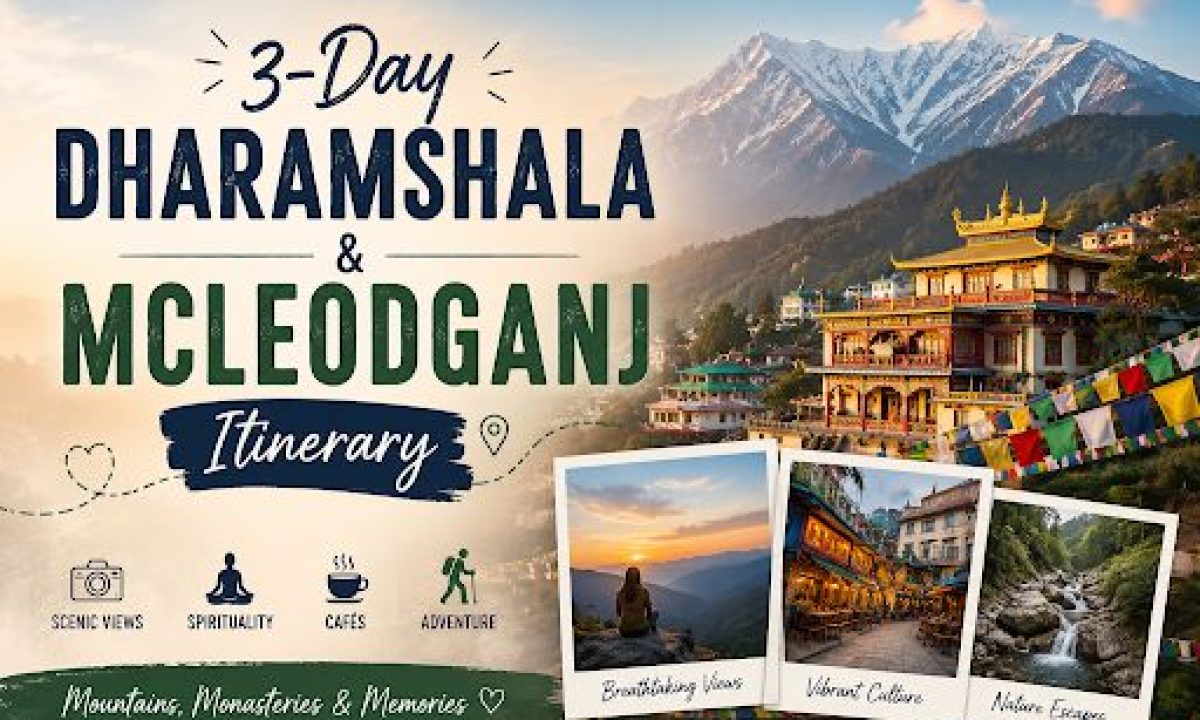
Dharamshala and McLeodganj together form one of the most rewarding travel destinations in northern India. Nestled in the Dhauladhar mountain range of Himachal Pradesh at an altitude of around 1,457 metres, this region offers a rare combination of Tibetan culture, Himalayan landscapes, ancient temples, adventure trekking, and a café culture unlike anywhere else in the country. Three days is enough time to experience the very best of what this region has to offer, provided you plan each day around the geography of the area.
This guide is written for travellers who want to make the most of every hour without rushing. It clusters each day by location so that you move logically through the terrain rather than spending your trip going back and forth across the same roads. Whether you are arriving by flight at Kangra Airport, by overnight bus from Delhi, or by train to Pathankot followed by a road transfer, this itinerary begins at the point of arrival and takes you smoothly through three unforgettable days.
Before You Begin: Understanding The Layout of Dharamshala
One of the most common mistakes first-time visitors make is treating Dharamshala and McLeodganj as the same place. They are connected but distinct. Lower Dharamshala is the administrative town, sitting at a lower elevation. It has the district offices, the HPCA cricket stadium, the bus stand, and the main commercial area. McLeodganj sits approximately 10 kilometres above at a higher elevation and is where most travellers choose to stay. It is home to the Tibetan Government in Exile, the Dalai Lama’s residence, the Tsuglagkhang Complex, and the majority of guesthouses, cafés, and tourist activity.
From McLeodganj, the villages of Bhagsu, Dharamkot, and Naddi are all within easy reach on foot or by a short cab ride. Kangra Fort and the Kangra Valley tea gardens are further away at approximately 20 kilometres and are best visited on a dedicated half-day with a local taxi.
Staying in McLeodganj puts you at the centre of almost everything covered in this itinerary. It is the strongly recommended base for a three-day trip.
How To Reach Dharamshala
By Air: The nearest airport is Kangra Airport (also known as Gaggal Airport, IATA code DHM), located approximately 15 kilometres from Dharamshala and 23 kilometres from McLeodganj. IndiGo and Air India operate regular flights from Delhi and Chandigarh. On arrival, the most reliable and convenient way to reach McLeodganj is by booking a pre-arranged taxi. Groove Taxi Services provides fixed-rate airport transfers from Kangra Airport to McLeodganj starting from ₹1,200, with drivers available for early morning and late-night flights.
By Train: The nearest major railway station is Pathankot Junction, approximately 85 kilometres from Dharamshala. From Pathankot, taxis and shared cabs are available for the two-hour drive to McLeodganj.
By Bus: Himachal Road Transport Corporation and several private operators run overnight buses directly from Delhi ISBT Kashmiri Gate to Dharamshala. The journey takes between nine and eleven hours depending on the route and traffic.
Day 1: Arrival And McLeodganj Core Exploration
Morning: Settle In and Begin at the Heart of McLeodganj
Your first morning in McLeodganj should begin at a relaxed pace. The town reveals itself best when you walk its lanes without a tight schedule. After checking into your accommodation, head directly to the Tsuglagkhang Complex, which is the spiritual and cultural heart of McLeodganj and the single most important site in the entire Dharamshala region.
The Tsuglagkhang Complex houses the main temple of the Tibetan Government in Exile, the residence of His Holiness the 14th Dalai Lama, the Namgyal Monastery, and the Tibet Museum. Entry to the complex is free and open to visitors of all faiths. The temple itself contains magnificent gold statues of the Buddha, Avalokiteshvara, and Padmasambhava. The atmosphere inside is deeply peaceful. Monks can be seen practising their daily prayers, spinning the prayer wheels that line the pathways, and debating in the monastery courtyard.
Spend at least ninety minutes here. The Tibet Museum, located within the complex, documents the history of Tibet and the story of Tibetan refugees in India through photographs, films, and written records. It is sobering and educational and should not be skipped.
Midday: The McLeodganj Main Market
After leaving the Tsuglagkhang Complex, walk through the main market of McLeodganj. This bustling stretch of shops and café-lined lanes sells everything from Tibetan thangka paintings and singing bowls to handmade jewellery, woollen shawls, and locally roasted coffee. For lunch, this area offers an excellent variety of Tibetan food. Momos (steamed or fried dumplings) and thukpa (Tibetan noodle soup) are the dishes most associated with McLeodganj and you will find excellent versions of both at small eateries throughout the market.
Afternoon: Dalai Lama Temple Road and Tibetan Institute of Performing Arts
In the afternoon, walk along Temple Road and explore the smaller monasteries, meditation centres, and art studios that line the route below the main market. The Tibetan Institute of Performing Arts (TIPA) is located nearby and is worth a visit if you are interested in traditional Tibetan opera, dance, and music. Occasional performances are held at the institute and the schedule can be checked on arrival.
Evening: Sunset from the McLeodganj Market Terrace Cafés
McLeodganj is famous for its rooftop cafés that offer views of the Dhauladhar peaks as the sun sets behind them. The light on the mountains in the late afternoon is genuinely spectacular. Spend your first evening at one of the many café terraces on Temple Road or the upper market area with a hot Kangra tea or a bowl of local soup. The famous Kangra tea, grown in the valley below, has a delicate floral flavour and is widely available throughout the region.
Day 1 taxi note: If you arrive by flight at Kangra Airport, you will need a pre-booked taxi to reach McLeodganj. Book your Kangra Airport to McLeodganj transfer with Groove Taxi Services for a fixed fare with no hidden charges.
Day 2: Bhagsu, Dharamkot, and Naddi Viewpoint
Morning: Bhagsu Village and the Bhagsu Nag Waterfall
Day 2 focuses on the villages that sit above and around McLeodganj, beginning with Bhagsu. The village of Bhagsu is located approximately 2 kilometres from the McLeodganj market and can be reached on foot in about 30 minutes by walking along the main road, or by a short local cab ride taking around five minutes.
Begin your morning at the Bhagsunath Temple, an ancient temple dedicated to Lord Shiva that dates back centuries and holds deep significance for Hindu pilgrims visiting the region. The temple sits beside a natural spring and the atmosphere around it in the morning is calm and serene.
From the temple, follow the trail upward for approximately one kilometre to reach the Bhagsu Nag Waterfall, which cascades down from a height of around 20 metres into a small rocky pool. The trail involves some climbing and the surface near the waterfall can be slippery, so footwear with a good grip is essential. The waterfall is most impressive between July and October when the water flow is at its highest, but it is beautiful in every season. Several small cafés along the trail serve food and hot drinks. The Shiva Café, which sits directly overlooking the waterfall, is one of the most photographed spots in McLeodganj and a genuinely lovely place to stop for breakfast.
Midday: Walk Up to Dharamkot
After returning from Bhagsu Nag Waterfall, take the trail that leads upward to Dharamkot, the quiet village above McLeodganj that sits at a slightly higher elevation with magnificent open views of the Dhauladhar range. Dharamkot is known for its meditation and yoga retreats, including the well-regarded Tushita Meditation Centre which offers introductory courses in Tibetan Buddhism throughout the year.
The village itself is small and unhurried. There are no major tourist attractions here in the conventional sense. What Dharamkot offers instead is the feeling of being in a genuine Himalayan village with mountain views, clean air, pine forest walks, and a handful of excellent cafés that attract long-term travellers and students from the meditation centres. Have lunch here. The food at the small guesthouses and cafés tends to be excellent.
Afternoon: Gallu Devi Temple and the Triund Trek Base
From Dharamkot, it is a short walk or a five-minute cab ride to the Gallu Devi Temple, which serves as the starting point for the famous Triund Trek. Even if you do not plan to complete the full trek (which takes around three to four hours one way to the top), walking the lower section of the trail for thirty to forty-five minutes gives you exceptional views of the valley and a genuine feel for the Himalayan landscape. The trail passes through oak and rhododendron forests and opens up gradually to reveal panoramic views of the Kangra Valley.
Those who want to complete the full Triund Trek should note that the summit at 2,828 metres offers a jaw-dropping 180-degree view of the Dhauladhar range and is one of the most rewarding easy-to-moderate treks in northern India. It is best done as an early morning start from McLeodganj, ideally departing by 6:00 AM to reach the top before midday clouds form.
Evening: Naddi Viewpoint
For the final stop of Day 2, arrange a taxi to take you to the Naddi Viewpoint, located approximately 3 kilometres from McLeodganj on a hilltop road. This viewpoint offers what is arguably the most expansive panoramic view available from the Dharamshala region, with the entire Dhauladhar range visible from end to end and the Kangra Valley stretching out below. On clear days, particularly in the early winter months, the snow-covered peaks are visible in stunning detail. The viewpoint is best visited in the late afternoon to catch the golden hour light on the mountains.
Day 2 taxi note: While Bhagsu can be reached on foot, Naddi Viewpoint and Gallu Devi Temple are most easily reached by a local cab. Book a local sightseeing cab with Groove Taxi Services for a comfortable full-day arrangement covering all these spots at a fixed rate from ₹2,300.
Day 3: Kangra Fort, Dal Lake, and the Kangra Valley
Morning: Dal Lake and St. John in the Wilderness Church
Begin Day 3 with a morning walk to Dal Lake, located approximately 2 kilometres from McLeodganj on the road towards Naddi. This small Himalayan lake, surrounded by deodar cedar trees and with a Shiva temple on its banks, is a peaceful spot for a morning visit. The lake is significantly smaller than its famous Kashmiri namesake but has a quiet, meditative quality. Early mornings here, when mist hangs over the water and the surrounding forest is still, are particularly beautiful. The area around the lake is good for birdwatching.
On the walk back toward McLeodganj, stop at St. John in the Wilderness Church, one of the oldest Anglican churches in the Himalayas. Built in 1852 during the British colonial period, the church is set within a dense forest of deodar trees and has a haunting beauty. The cemetery within the grounds contains the graves of British officers, including Lord Elgin, the Viceroy of India who died in Dharamshala in 1863. The church is rarely crowded and is a genuinely atmospheric place to visit.
Midday: Drive to Kangra Fort
After returning to McLeodganj for a late breakfast or early lunch, begin the drive to Kangra Fort, located approximately 20 kilometres from McLeodganj in the town of Kangra. This is a journey of about forty minutes by taxi and is most comfortably done with a pre-arranged vehicle so that you are not waiting for a return cab from a relatively remote location.
Kangra Fort is one of the oldest and largest forts in the Himalayas, originally built by the royal family of Kangra in the 4th century BC. The fort sits atop a rocky hillock at the confluence of the Banganga and Manjhi rivers. Its strategic position and natural defences meant it was fought over by Mughal emperors, Sikh rulers, Gurkha armies, and finally came under British control. The fort was significantly damaged by the 1905 Kangra earthquake but the surviving structures, including the Ambika Devi and Lakshmi Narayan temples within the fort complex, remain impressively intact. The views of the surrounding Kangra Valley from the fort walls are exceptional.
Allow at least ninety minutes at Kangra Fort. Entry is managed by the Archaeological Survey of India and a nominal entry fee applies.
Afternoon: Kangra Valley Tea Gardens and Masroor Rock Temples
From Kangra Fort, those with time and interest can visit the Kangra Valley Tea Gardens near Palampur, approximately 35 kilometres further along the valley. Kangra tea is one of India’s oldest and most distinctive teas, with a light golden colour and floral aroma quite different from the stronger Assam or Darjeeling varieties. Many of the tea estates welcome visitors and allow you to walk through the gardens and observe the processing facilities. It is a worthwhile detour if you have the afternoon free.
Alternatively, the Masroor Rock Temples, located about 35 kilometres from Kangra, are a remarkable group of early 8th-century rock-cut temples carved from a single sandstone ridge in the style of the famous temples at Mahabalipuram. They are relatively little-visited compared to Kangra Fort and offer a quietly extraordinary experience for those interested in ancient Indian architecture.
Evening: Return to McLeodganj and Departure Preparations
Return to McLeodganj in the late afternoon. If you are departing the following morning by flight from Kangra Airport, this is a good time to confirm your taxi booking for the airport transfer. If you are continuing onward to Manali, Chandigarh, Amritsar, or Dalhousie, Groove Taxi Services provides fixed-rate outstation transfers to all major destinations from Dharamshala.
Spend your final evening walking the McLeodganj market one last time, picking up any remaining souvenirs, and having a proper sit-down dinner at one of the town’s better restaurants. The Korean, Israeli, Italian, and Tibetan food options in McLeodganj are all genuinely good, reflecting the international mix of travellers who have made this town their temporary home over the decades.
Practical Travel Information
Best time to visit: March to June and September to November offer the most pleasant weather for sightseeing. December to February brings snowfall and cold temperatures but the landscapes are beautiful. July and August (monsoon season) bring heavy rainfall and some road disruptions, though the waterfalls and greenery are at their most dramatic.
Where to stay: McLeodganj has accommodation for every budget, from basic guesthouses at ₹500 per night to comfortable boutique hotels at ₹3,000 to ₹5,000 per night. Booking in advance is strongly recommended during peak season (April to June and October).
Getting around: The most convenient and cost-effective way to cover multiple attractions in a single day is by booking a local sightseeing cab. Groove Taxi Services offers full-day local sightseeing packages from ₹2,300 with an experienced driver who knows every route in the Dharamshala and Kangra region. Pre-booking ensures a fixed price with no negotiation required.
What to carry: Comfortable walking shoes are essential as many attractions involve uneven terrain and steps. A light jacket is advisable even in summer as evenings at this elevation can be cool. Carry cash as several smaller establishments and temple complexes do not accept digital payments.
Book Your Dharamshala Transfers with Groove Taxi Services
Whether you need an airport pickup from Kangra Airport, a full-day local sightseeing package, or an outstation taxi to Chandigarh, Manali, Dalhousie, or Amritsar at the end of your trip, Groove Taxi Services provides reliable, fixed-price cab service across Dharamshala, McLeodganj, and Himachal Pradesh.
With over 20 years of experience, a 5.0-star Google rating, licensed and professionally trained drivers, and transparent pricing with no hidden charges, Groove Taxi Services is the trusted choice for travellers visiting the Kangra Valley.
Call or WhatsApp: +91 78760 44831
Available 24 hours a day, 7 days a week
Book online at groovetaxiservices.com
Also read: Taxi Service at Kangra Airport | Local Sightseeing Cab in Dharamshala | Dharamshala to Chandigarh Taxi | Dharamshala to Dalhousie Cab

As a locally rooted taxi service, Groove Taxi Services shares insider knowledge of Dharamshala and the Kangra Valley. From hidden gems to popular attractions, our team helps travelers discover authentic experiences with comfort and convenience. Backed by excellent customer reviews on Google and Justdial, we are known for reliable service, professional drivers, and a commitment to customer satisfaction.